

Music Production / AI
Novakk
“Creativity Cannot be delegated” — Introducing FLWO
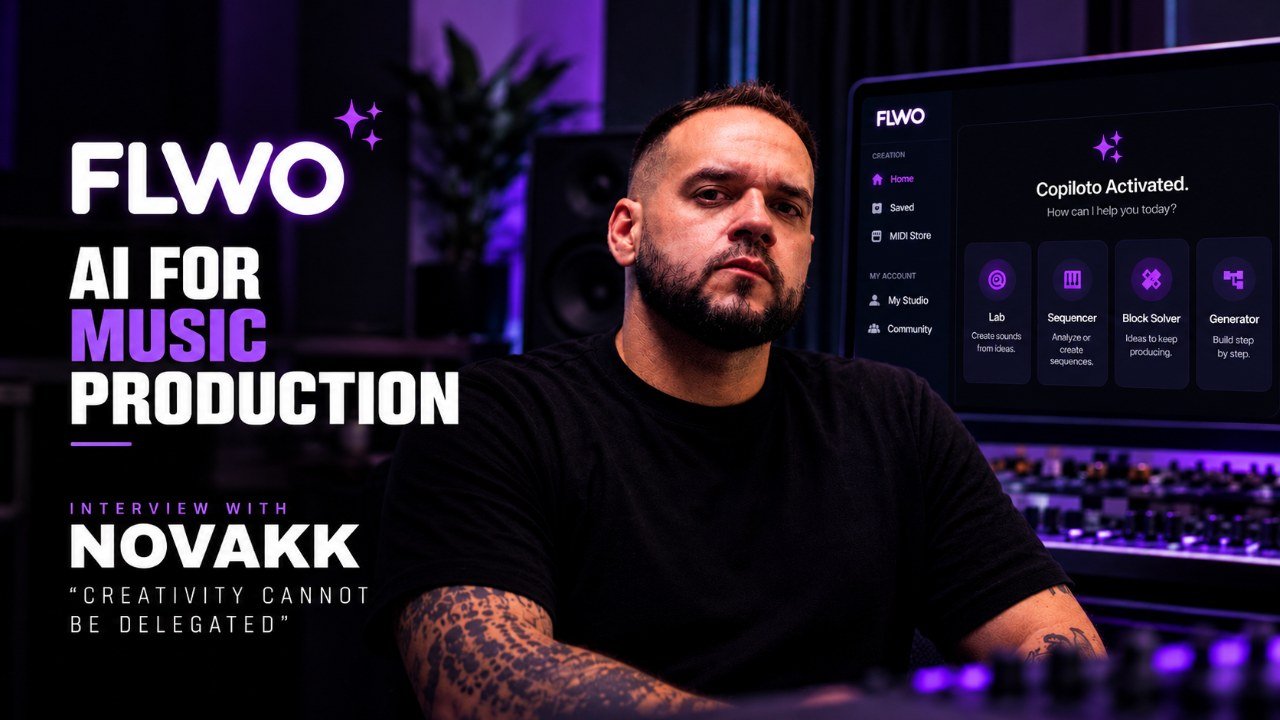
Novakk introduces FLWO, an AI-powered tool helping music producers break creative blocks, speed up their workflow and explore new ideas without compromising their artistic identity. Technology as a creative ally, never a replacement for the artist.
-
01. First of all, what inspired you to develop FLWO, and where did the idea come from?
Novakk
First of all, I’d like to thank you for inviting me to be part of this first interview on your platform. It’s an honour.
I’ve been involved in music for many years, but I’ve also spent a significant amount of time teaching music production, something not everyone knows about. That’s where this idea came from.
I’m always interested in new developments, and when I saw the rise of artificial intelligence, I started experimenting with it quite some time ago. After more than a year exploring its creative capabilities, I realised how impressive they were, but I also felt that they could take something away from the artist.
That’s when I came up with the idea of creating a tool that could act like a teacher, guiding producers without taking away their creativity. Something that helps you make decisions faster.
-
02. What problem were you trying to solve with FLWO?
Novakk
The problem wasn’t just my own. I constantly saw it among the people I teach.
When a student gets stuck in the middle of a session, I can’t always be there to help at any time. They end up searching for tutorials, getting distracted or simply waiting for an answer. That frustration can eventually make them abandon an idea altogether.
If you want to preserve creativity, you can’t afford to break the flow.
FLWO was born out of that need: giving producers immediate answers so they can keep moving forward while the inspiration is still there.
-
03. How does FLWO differ from AI platforms that generate complete tracks?
Novakk
It was essential to establish that difference because the goal isn’t to make music with the push of a button.
My partner and developer raised concerns about copyright and the potential risks of creating FLWO, given the issues other applications have faced. I explained that our approach was fundamentally different, and that’s how we began developing the idea.
Platforms that generate finished music take away much of the essence of art and leave little room for the user to build something of their own.
I wanted to create a tool you could interact with: a studio assistant that suggests an idea, a chord or a technique when you get stuck, allowing you to edit it, experiment with it and learn along the way.
FLWO is designed to empower producers and accelerate their workflow, not replace their judgement or copy other artists. Users need to understand that distinction.
-
04. Can artificial intelligence and artistic identity really coexist?
Novakk
Creativity cannot be delegated. If you ask a machine to make the important decisions for you, what kind of artist are you?
It’s like hiring someone to make your music and then putting your own name on it.
For me, AI is an incredible resource for learning, experimenting with unusual ideas and speeding up certain processes. But the judgement and the signature must remain yours.
The machine suggests and teaches, but the artistic control should always be yours.
-
05. How has working with FLWO changed your own creative process?
Novakk
The biggest change is that I no longer waste hours getting stuck while searching through tutorials. Now, I can simply ask my questions and receive assistance immediately.
As producers, we’re also inspired by artists we admire, and sometimes it’s difficult to recreate certain sounds or techniques just by listening.
The tool analyses those techniques and teaches me how to achieve similar results using my own instruments, so I can adapt them to my style.
That allows me to move forward faster while keeping the inspiration alive.
-
06. Can AI help producers overcome creative blocks without taking away the creative process?
Novakk
Absolutely. Creative block is the real enemy in the studio. It drains your energy and makes you question your ideas.
Having a tool suddenly suggest an arrangement, a bass variation or a different progression can be incredibly useful. It doesn’t give you the finished track; it gives you the impulse you need to keep going.
It offers different perspectives in seconds, helps you break out of a mental loop and allows you to make the final decision with a fresh perspective.
-
07. How can producers use AI without losing their signature sound?
Novakk
Your identity doesn’t depend on the tool you use, but on the decisions you make as a creator.
It’s very similar to sample libraries. If ten producers use exactly the same sample pack without changing anything, they’re going to sound alike.
Someone who simply drags a loop into a track will sound like everyone else. But someone who chops it up, processes it and transforms it can build something entirely their own.
The same applies to AI. If you let it do everything for you, you lose your signature. But if you use its suggestions as a starting point, adding your own variations, modifying parameters and applying your judgement, the tool becomes something that works for you.
Your own sound comes from personalisation.
-
08. Which FLWO feature best represents the philosophy behind the project?
Novakk
I’d choose “Laboratory”. It was the first idea I had for solving the problem of wasting time searching for sounds, because it helps you create exactly the sounds you have in mind or the ones you’ve heard in another track.
And, of course, the tool designed to overcome creative blocks is essential for keeping creativity flowing, because blocks and doubts are always part of working in the studio.
I’d say those two features best represent the philosophy behind FLWO.
-
09. How do you imagine music production five years from now?
Novakk
I imagine a much more efficient studio, where AI takes care of the tedious work and repetitive or mechanical tasks that currently drain our energy.
And, of course, I see AI acting as an assistant, helping us throughout the creative process.
I believe AI will significantly change the way we learn, not just in music but across many different fields.
-
10. What has developing FLWO taught you about the way producers work and learn?
Novakk
The process didn’t bring any major surprises. Instead, it confirmed what I already suspected: creative blocks are real, and technology can help us overcome them without having to rely on complex tutorials.
That’s the main thing I hope people understand.
Every artist wants to finish tracks and move forward in their career. If you keep using the same methods, you’ll keep moving at the same pace.
Experimenting with new tools that can accelerate your learning is essential if you want to progress as an artist and reach your goals.
If you keep doing the same things and aren’t getting the results you want, why refuse to try something new?
-
11. What will ultimately distinguish human-made music from music created by artificial intelligence?
Novakk
Human error will always make the difference.
How many discoveries have we made through mistakes or pure coincidence? That’s one of the most beautiful things about music. So many things in music history have emerged by accident, through experimentation or by stumbling across something unexpected.
A machine cannot experience that in quite the same way because it tends to follow established patterns and play it safe. It doesn’t take risks or explore the unknown in the same way a human artist can.
That’s where the real difference lies: in the details that give human-made music its value. Those subtle nuances can be felt and appreciated as soon as you hear them.
ELECTRONIC CLUBBING MOVEMENT (ECM)
Exploring the ideas, people and technology shaping electronic music culture.


